

Lifecycle Reliability: Why Cycle Testing Matters
Want To Try Our Services ?
IC GROUP was borne out of a collaboration with Kingspan Light + Air in ESS management. ICG has its financial + legal headquarters in Dubai.
IC Colt operates across sub-Saharan Africa and COMESA countries.

Introducing IC Colt – Certified Partners to Kingspan Light + Air International and the Light + Air + Water brands including Colt International in Sub-Saharan Africa and COMESA.
TALK TO US
Lifecycle Reliability: Why Cycle Testing Matters
Smoke ventilation cycle testing is rarely considered on the day systems are installed, yet it determines whether those systems will still operate years later when they are needed most.
Smoke and heat control systems may sit quietly above our heads for years. When a fire occurs they must deploy instantly and perform exactly as designed.
Lifecycle reliability in smoke control systems: the key engineering question
When engineers evaluate smoke control equipment, discussion often centres on certification. Has the product been tested? Does it carry the correct classification? Is there a Declaration of Performance?
All of those questions are essential. They are also only the starting point.
Lifecycle reliability in smoke ventilation depends on verified certification documentation
Certification claims should always be verified against the official notified body test reports, the Declaration of Performance, and Factory Production Control documentation. In many markets the assumption that these documents have been checked can lead to specifications being approved without full verification.
Yet one critical question is often overlooked:
How many times can the system operate reliably before failure?
This is where cycle testing becomes a vital measure of engineering durability.
Smoke ventilation cycle testing and lifecycle reliability
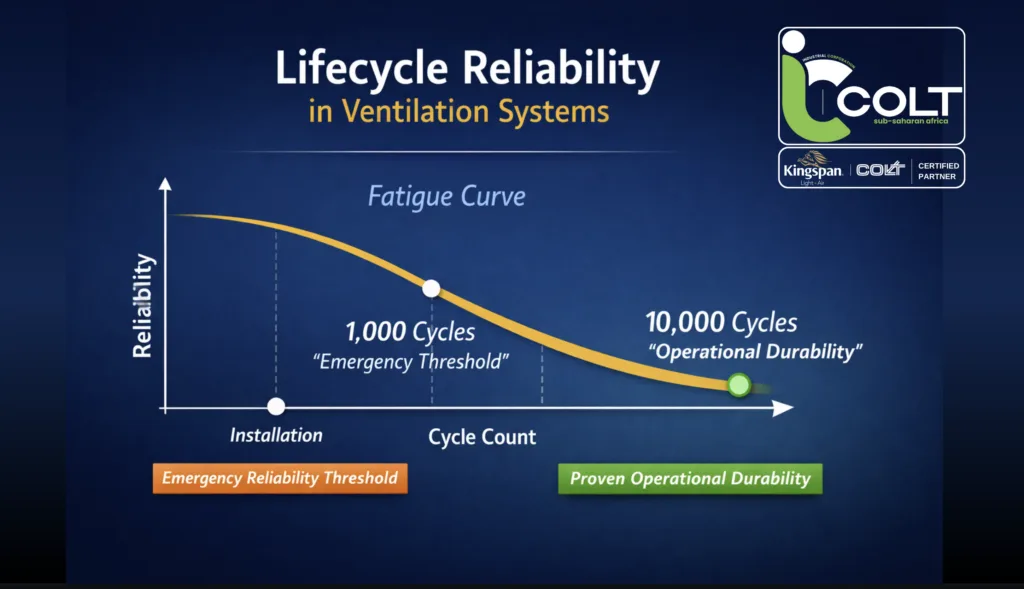
Cycle testing measures how many open and close movements a system can complete successfully while maintaining performance. Engineers can therefore evaluate durability across the life of the building rather than only at installation. Different smoke control components are evaluated under different standards depending on the product type.
Each cycle represents a full operational movement of the equipment. For instance:
- A ventilator opening and closing
- A curtain deploying and resetting
- A damper activating and returning to standby
The purpose of the test is to simulate years of operation within a controlled environment so engineers can observe how mechanisms behave across repeated movement.
Cycle classifications and lifecycle reliability in smoke ventilation systems
In many smoke and heat control applications two durability levels commonly appear.
1,000 cycle durability (Re 1,000 under EN 12101-2)
This classification is typically associated with systems designed primarily for emergency deployment. Equipment often remains idle for long periods and operates only during inspection tests or during the rare event of a fire.
10,000 cycle durability (Re 10,000 under EN 12101-2)
Engineers select higher cycle classifications when equipment must operate repeatedly throughout the life of the building. This includes systems that provide daily environmental ventilation while remaining ready for emergency smoke extraction.
Moreover, within the Colt and Kingspan Light plus Air engineering portfolio, many natural smoke ventilators are designed and tested to demonstrate Re 10,000 durability under EN 12101-2 reliability classifications. This confirms the ventilator assembly has successfully completed 10,000 operational cycles during testing. This testing confirms that the ventilator structure, hinges, actuators and linkage mechanisms continue to operate reliably after thousands of movements.
This distinction is particularly relevant in large industrial buildings where ventilators perform two roles at once: day to day natural ventilation and emergency smoke exhaust.
The difference between these durability levels is significant. It reflects the expected operational reality of the building.
Smoke control systems in daily ventilation and emergency operation
Many modern industrial buildings combine two functions within the same equipment.
Natural smoke and heat ventilators may be used to:
☞ release heat during normal building operation
☞ provide comfort ventilation
☞ support routine testing and commissioning procedures
☞ operate as part of an emergency smoke extraction system
Therefore, because these ventilators may open and close regularly, the mechanical systems within them must withstand repeated movement over many years.
By contrast, curtains often remain in standby as reservoir boundaries and only deploy during testing or emergency events. Their durability may be demonstrated through continuous cycle testing under standards such as DIN 4102-18, where systems can be tested for 10,000 continuous deployment cycles to verify long term mechanical reliability. However, their deployment mechanisms must still operate reliably after years of inactivity.
Understanding how equipment will actually be used is therefore central to selecting the correct durability classification.
Mechanical fatigue risks in smoke control systems
Mechanical systems degrade gradually with repeated use.
Actuators, drive mechanisms, linkages, springs and control components all experience stress each time they move. Over hundreds or thousands of cycles, small amounts of wear accumulate.
Without proper design and testing this wear can eventually lead to failure.
The challenge is that such degradation is rarely visible during routine inspections. A system may appear intact while internal components are approaching the limits of their mechanical endurance.
Cycle testing helps engineers identify these risks before equipment is placed into service, allowing potential failures to be addressed long before installation.
Actuator reliability in smoke control systems
Actuators form the heart of most automated smoke control systems. Whether electric, pneumatic or mechanical, they translate control signals into physical movement.
In ventilators and automated systems they must deliver reliable opening forces while maintaining precise positioning.
Over time, actuator reliability becomes one of the most critical determinants of system performance.
Higher durability classifications provide confidence that actuator systems can continue operating reliably through years of building use and maintenance testing.
Maintenance: the other half of reliability
Testing alone does not guarantee lifecycle performance.
Smoke control systems require structured maintenance programmes that verify system operation throughout the life of the building.
Regular inspection and testing ensure that:
- moving components remain functional
- control systems respond correctly
- actuators deliver the required forces
- safety systems deploy within expected timeframes
When durability testing and maintenance regimes work together, long term reliability becomes achievable.
EN testing philosophy
European standards governing smoke and heat control systems place strong emphasis on repeatable performance.
Certification confirms that equipment meets defined performance criteria under controlled test conditions. Furthermore, cycle testing demonstrates that these mechanisms continue operating after repeated movement.
Together these requirements form the engineering philosophy behind modern smoke control standards:
Performance must be proven.
And performance must remain dependable over time.
Why lifecycle thinking matters for building owners
For building owners and operators the implications are straightforward.
Selecting equipment based only on initial certification can overlook lifecycle reliability in smoke ventilation systems and the operational reality of the building. Durability classifications therefore become an important decision factor.
A system designed for limited emergency deployment may not be suitable in facilities where ventilation systems operate daily.
Understanding durability classifications allows owners, engineers and insurers to select equipment that aligns with the building’s true operational profile.
Roof integrity and engineered smoke ventilation
Importantly, engineers design properly engineered smoke ventilation systems to protect both life safety and the building envelope. When Kingspan Light + Air International (KLAI) and Colt International (Colt) ventilator solutions are installed and signed off through accredited processes, roof integrity and weather performance are engineered into the system design from the outset. Leakage or weather ingress is therefore not expected when these certified systems are correctly installed, commissioned and maintained in accordance with their tested configuration.
Roof ventilation openings form part of the building envelope. When they are incorporated into smoke control strategies they also become part of a life safety system.
This is where an important distinction exists between simple roof openings and engineered smoke ventilation systems.
Static openings or basic roof ventilation components may address airflow requirements, yet they are not necessarily designed or tested as smoke control equipment. Weather resistance, aerodynamic behaviour, actuator integration and long term mechanical durability are rarely engineered together within a single certified system.
Engineered smoke ventilators, by contrast, are designed as complete assemblies. The structure, hinges, actuators, control interfaces and aerodynamic performance are all tested together under recognised standards.
Within the KLAI) and Colt engineering portfolio, ventilators are tested as integrated systems. Cycle testing confirms mechanical durability while aerodynamic testing confirms smoke extraction performance.
When these systems are installed and signed off through accredited processes the objective is predictable performance across the lifecycle of the building while maintaining roof integrity and reliable smoke extraction capability.
The engineering takeaway
Ultimately, lifecycle reliability in smoke ventilation systems transforms smoke control from a theoretical safety measure into a dependable building system.
Cycle testing provides insight into lifecycle reliability in smoke ventilation systems and mechanical durability.
Maintenance preserves that reliability throughout the life of the building.
Together they ensure that when a fire occurs, the system performs exactly as designed.
Coming Next
This article forms part of a wider governance-led series examining operational fire safety beyond handover.
Next in the series:
ISO is not EN: Why Factory Production Control Matters
About IC Colt (Pty) Ltd : IC Colt is the exclusive certified Sub-Saharan territory partner to Kingspan Light + Air International, including Colt International. The company specialises in fire safety, sustainable ventilation systems, and EN-compliant solutions tailored for public infrastructure, commercial buildings, and industrial facilities.
IC Colt | Colt International | Kingspan Light + Air
Media inquiries: press@icorpgrp.com
ACRONYMS
EN: European Norm
DoP: Declaration of Performance
FPC: Factory Production Control
NSHEV: Natural Smoke and Heat Exhaust Ventilator
NANDO: New Approach Notified and Designated Organisations List
SANAS: South African National Accreditation System
IC Colt Zambia, Kingspan Light + Air, Zambia, Colt International Sub-Saharan Africa, smoke ventilator cycle testing, EN 12101 reliability class Re 1000 Re 10,000, EN 12101 smoke ventilator testing, Re 10,000 ventilator meaning, smoke ventilation durability class, smoke and heat control system durability, natural smoke ventilator testing standards, industrial smoke ventilation lifecycle, mechanical reliability smoke control systems
Colt in African Mining, heritage to modern EN strategy
Colt’s heritage in South African mining since the 1950s shows how performance-led ventilation stands up to heat, dust, and continuous...

ISO is not EN FPC: Why Factory Production Control Matters
ISO 9001 confirms how a company manages quality. EN certification with Factory Production Control confirms that a life safety product...
Lifecycle Reliability: Why Cycle Testing Matters
Smoke and heat control systems may sit above a building for years before they are ever needed. When a fire...